
Key Highlights:
- AI Dominates Recruiting – 82% of companies now use AI to review resumes, with many also adopting chatbots, using it for interviews and assessments.
- Smarter AI Tools, Tougher Filters – Predictive analytics and NLP improve speed and accuracy but can still filter out qualified candidates if resumes aren’t AI-friendly.
- Candidates Remain Cautious – Despite the efficiency gains, job seekers remain concerned about bias and rigid filters overlooking their skills.
Three years after our first look at AI recruiting, the technology has grown far beyond Applicant Tracking Systems. Today, AI scans resumes, predicts performance, and engages candidates through chatbots. For engineers, this can speed up applications but it also means that algorithms, not people, may decide your fit. Here’s what’s new and how these changes could impact your job search:
More companies are embracing AI in recruiting
AI is now a major part of recruitment: 82% of companies use it to review resumes, with many also adopting chatbots, interview tools, and assessment reviews. For hiring teams, efficiency is the biggest advantage. Companies using generative AI in hiring report an average time savings of 20% per week, an equivalent of a full workday saved.
Why more hiring managers use AI:
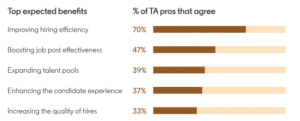
New in AI Recruiting
- Advanced Screening & Predictions
Modern AI recruiting software processes thousands of applications using complex criteria beyond keyword matching. One global company receiving 2 million applications annually cut its hiring timeline from 4 months to 4 weeks.
- Predictive Analytics for Better Hiring Decisions
AI now predicts candidate performance in specific roles using advanced Natural Language Processing (NLP) to match resumes to job descriptions and past performance data, boosting candidate quality scores by 35% over traditional keyword searches. However, risk-averse filters can still reject candidates with employment gaps or unusual career paths if resumes aren’t AI-friendly.
- Enhanced Candidate Engagement
AI-powered chatbots now schedule interviews, provide application status updates, and conduct preliminary screenings with 24/7 availability. This real-time support improves candidate experience while reducing administrative burden. According to Phenom’s 2025 report, conversational AI drives application completion rates 3x and raises satisfaction scores by 25%.
Most job seekers remain cautious about AI screening resumes or making final decisions. This concern is valid since AI can miss qualified talent due to skewed training data that leads to unintentional bias, creating real risk of being overlooked despite having the right skills.
What do these improvements mean for engineering candidates?
- Faster hiring timelines: Engineering positions traditionally have the slowest hiring timeline, but AI-driven screening and chatbots can help speed up applications, cutting weeks or even months off traditional processes. Engineers should learn to interact effectively with AI chatbots during initial screenings by using clear, specific technical language and providing direct answers that align with job requirements, as these systems are designed to quickly identify relevant skills and move qualified candidates forward.
- Engineer-specific keywords matter: AI-driven ATS tools use automation and predictions to match resumes with job descriptions, and engineering resumes that align closely are ranked higher. Adding relevant skills and keywords (such as technical terms, certifications, software, and quantifiable results) makes your resume more AI-friendly and increases your chances of being noticed.
- Read this ARTICLE to learn how to tailor your resume to stand-out.
- Predictive analytics can highlight technical strengths: Engineers can leverage this by quantifying their product development impact with specific metrics like “reduced product development cycle by 30%,” “decreased manufacturing costs by $200K through design optimization,” or “improved product reliability by 40% through enhanced testing protocols.” These measurable outcomes help AI algorithms identify you as a high-potential candidate by matching your demonstrated results to successful performance patterns in product development roles.
- Nonlinear career paths may be overlooked: 88% of HR leaders found that automation tools had rejected strong applicants for missing a few skills or having valid career gaps. Engineers should proactively address career transitions or gaps with brief explanations in their resumes, such as “transitioned from aerospace to medical devices to leverage structural design expertise” or “completed embedded systems certification during career break.” This helps AI systems understand the strategic nature of your career decisions rather than viewing them as red flags.
Navigating this AI-driven recruiting landscape requires understanding both its advantages and limitations.
While AI recruiting tools can accelerate hiring timelines and more accurately match technical skills to job requirements, they may also overlook qualified engineers with non-traditional backgrounds, career gaps, or resumes that aren’t optimized for algorithmic screening.
Ready to have your qualifications presented by someone who understands your full potential? Connect with a SoloPoint Solutions Technical Recruiter who can advocate for your skills, provide context that algorithms miss, and present your complete engineering story directly to hiring managers.