
Key Highlights:
- AI Screens Out Good Candidates – Rigid algorithms reject qualified applicants over missing keywords or career gaps while missing soft skills that matter most.
- AI Can Be Biased and Risky – Training data creates discrimination against age, gender, and race, leading to lawsuits and legal problems.
- Humans Are Still Essential – Candidates want human connection, and recruiters provide judgment and emotional intelligence that AI cannot replace.
The recruitment landscape has undergone a dramatic transformation as artificial intelligence becomes increasingly integral to hiring processes. With 82% of companies now using AI to review resumes and nearly two-thirds relying on it for candidate assessments, this technology promises unprecedented efficiency in processing large volumes of applicants. However, beneath this technological advancement lies a complex web of challenges that highlight why human expertise remains irreplaceable in making quality hiring decisions.
I. More companies are using AI for recruiting
AI is now everywhere in recruitment: resume screening, chatbots, assessments, and even interviews. It’s fast, efficient, and capable of processing large volumes of applicants, but it’s not flawless. Behind its efficiency are blind spots that risk screening out qualified talent. Here’s why AI is not fully reliable in recruiting and why the human touch still matters:
II. The challenges for hiring managers:
- AI screens out qualified candidates:
More than half of hiring managers worry that AI screens out qualified candidates often because they don’t have the “right” keywords on their resumes. In fact, 88% of HR leaders discovered that their automation tools have rejected strong applicants who were only missing a few specific skills or had valid career gaps.
AI-driven algorithms are great at matching candidate skills to relevant job descriptions, but it struggles to identify soft skills, adaptability, or cultural fit, the qualities that often make the best hires.
- AI can be biased:
46% of companies fear that AI could introduce bias related to age, gender, or race. This algorithmic bias often comes from biased training data, which can be deeply embedded in the code and hard to detect. As a result, AI may unintentionally favor certain schools, credentials, backgrounds, locations, or identities.
A University of Washington study have found algorithms ranking resumes differently by race and gender. One example is Amazon’s previous AI hiring tool in 2018, which was trained on male-dominated resumes and downgraded women’s applications. In severe cases, this can escalate to legal action, such as the lawsuit against tech firm Workday, which alleges its screening technology discriminated against applicants over the age of 40.
- Other challenges in AI
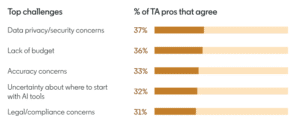
AI also brings challenges and risks for hiring managers. Top challenges include data privacy risks from handling sensitive candidate information, budget constraints due to the high cost of tools, and accuracy concerns when AI misinterprets resumes or reflects bias. Many also face uncertainty about where to start in a crowded vendor market and legal or compliance risks as evolving regulations demand proof of fairness, with violations potentially leading to penalties, lawsuits and reputational damage.
III. Concern from Job Seekers
While hiring managers grapple with these operational challenges, job seekers are developing their own concerns about AI-driven recruitment processes. This disconnect between employer implementation and candidate acceptance creates a trust gap that can ultimately undermine hiring success. Understanding why candidates are hesitant about AI in hiring reveals critical insights for organizations looking to balance efficiency with candidate experience.
- Lack of transparency: Most of job seekers want companies to be upfront about AI use in recruiting, but many aren’t clear on how it’s applied.
- Biased decision-making: 67% feel “uncomfortable” with AI reviewing resumes or making hiring decisions.
- Impersonal experience: Nearly half of job seekers turned down a job offer because of a poor candidate experience, often due to lack of communication or impersonal processes.
- Lack of human connection: Candidates still value human interaction. 48% don’t trust AI to accurately interpret human emotions or cues and 38% feel they couldn’t gauge an interviewer’s reactions with AI.
IV. Why “the human touch” is still needed for recruiting
Candidates expect and value human interaction, whether interviews are online or in person. Most job seekers are cautious about AI in hiring and only prefer it as a support tool for tasks like scheduling or sourcing. Human professionals can provide empathetic feedback after rejections and decipher personal nuances when reviewing resumes that AI can’t replicate. This personal connection is essential to a positive candidate experience, and while AI can assist with assessments, the final hiring decision should rest with human recruiters.
AI can make mistakes based on flawed data but lacks the ability to adapt to feedback or self-correct, as it has little understanding of consequences. Humans, however, can adjust their approach, consider context, make judgments, and improve through trial and error.
To ensure fair and ethical hiring, recruiters must use unbiased data, monitor AI outputs, and cross-check results to correct any biased data instead of relying solely on the technology.
The future of recruitment lies in striking the right balance—leveraging AI to handle routine tasks while empowering skilled recruiters to focus on what they do best: building relationships, assessing cultural fit, and making nuanced decisions that algorithms simply cannot replicate.
Experienced staffing professionals bring irreplaceable industry knowledge, extensive networks of passive candidates, and the emotional intelligence needed to navigate complex hiring decisions. They understand market context, recognize transferable skills, and can assess the intangible qualities that separate good hires from great ones.
Contact SoloPoint Solutions to discover how our expert recruiters specialize in sourcing hard-to-find engineering talent and can help you find the perfect candidates that AI alone would miss: